This animation, created for us by Reuben Murray, shows Newhaven’s three bridges which have linked both sides of the town since the 1780s. An audio described version of the animation can be found at the end of the blog.
Newhaven’s First Bridge
Before the 1780s the only way to cross the river at Newhaven was by boat. From at least 1332, a small ferry boat took passengers across the river from the bottom of the High Street.
In 1783, local businessmen petitioned King George III for permission to build a bridge. Permission was granted the following year and £1,675 was raised to build the bridge and toll house and to compensate Henry Bates, the last ferryman, for his loss of income. A standby ferry was also provided in case the bridge became impassable.
At the time, Newhaven was known for its ship building, so a drawbridge was built to let ships pass from the shipbuilders up the river from the bridge. It also allowed river traffic to travel up to Lewes and beyond. Although a toll was charged for crossing the bridge, all vessels were to have ‘free and unhindered passage’ under it.
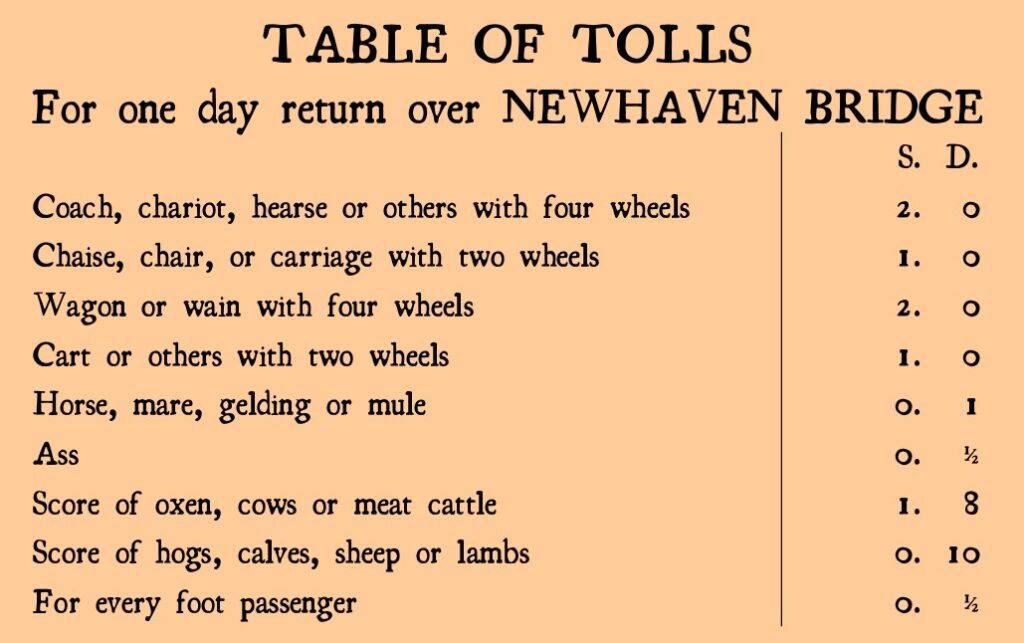
Residents of Denton were allowed to pass over the bridge free of charge, in recognition of them having maintained the Long Drove (now known as the Drove), at their own cost.
It took five men to operate the drawbridge equipment, which pulled the two centre sections back towards the river banks, as shown in the animation.
The 1866 Swing bridge
In the 1860s plans were drawn up, to improve the harbour, which included making a new cut to straighten the river. This cut created Denton Island, meaning the drawbridge would no longer link to the East side of the river and Seaford beyond.
A new swing (or pivot) bridge was built, opening at 12 noon on 22nd December 1866, the same time that the old bridge took its last toll from a man who crossed it with a companion. The new bridge could be crossed free of charge.
A new road, Bridge Street, was laid at the bottom of the High street, diverting traffic to the new swing bridge, which in turn led traffic across the river, linking it to the Long Drove. As well as traffic, the new bridge also carried a gas line and a tramway, originally built to facilitate the building of the breakwater.
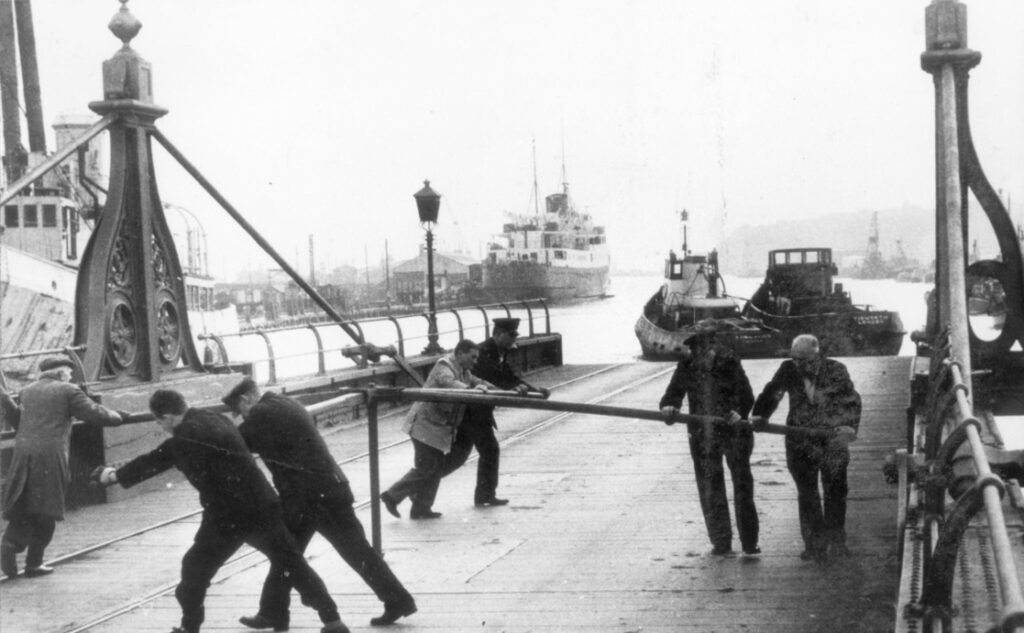
To open the bridge, the gates were closed at each end, the gas line was shut off and a capstan was set up in the middle. Poles were put into the capstan and it took eight men to swing the bridge open.
Photo: The 1866 swing bridge being swung open. Copyright: Newhaven Historical Society.
The 1974 Swing Bridge
Even though the 1866 swing bridge was strengthened in 1900 and 1939, the weight and increasing volume of traffic meant it had to be replaced.
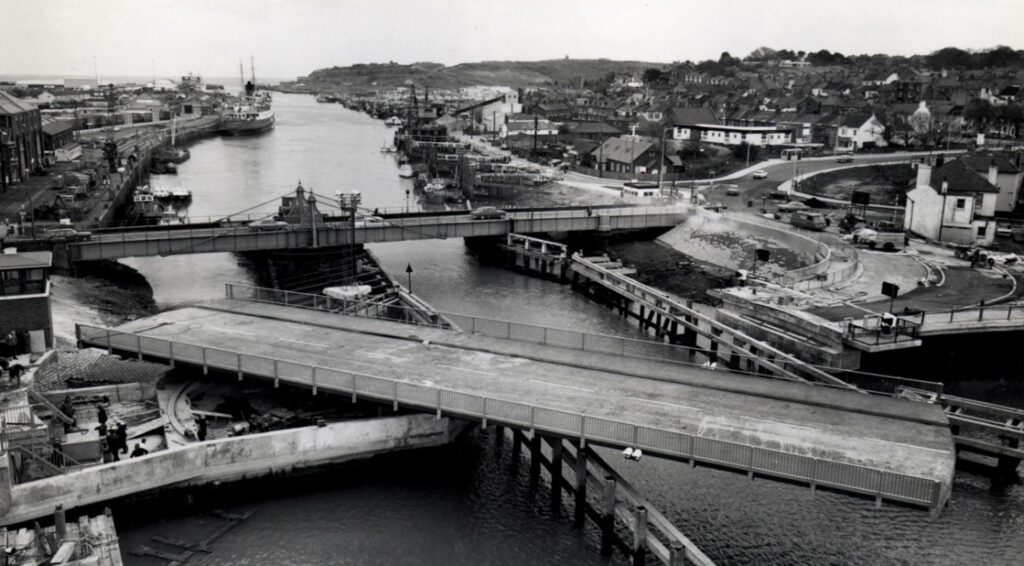
Work on the new swing bridge began in 1972, together witha new road layout which diverted traffic away from the High Street by creating a one-way system around the town centre from the bottom of Brighton Road. The new bridge was situated about 50 metres south of the 1866 bridge. It cost £1 million and was opened on 7th November 1974.
Traffic lights and half barriers control the traffic, whilst opening and closing the bridge is done by one person from the control tower.
It takes around 90 seconds to open the bridge, compared to the 3 minutes taken by the old bridge, although the traffic is held up by roughly the same amount of time.
Photo: The 1974 swing bridge being tested with the 1866 swing bridge carrying traffic. Copyright: Newhaven Historical Society.
Audio Described Three Bridges Animation